|
|
|
|
The Golden Years |
|
When were surfing’s Golden Years? I suppose it all depends on when you started surfing. For a lucky few it was the thirties, forties or
fifties. For me, they started in the late-fifties before the movie
‘Gidget’ helped turn surfing into a mass marketing commodity. They
lasted until 1970, when I returned to Malibu after two years of living
on Maui, Hawaii. By that time, the ‘shortboard revolution’ had virtually
wiped-out Southern California's traditional surfing culture - a
culture that focused on fun, personal challenge, mutual enjoyment and a
respect for the coastal environment. Within what seemed like a few short
years, it was replaced with an aggressive, mercenary new culture that
focused on performance, competition, self-gratification and greed. Then
I guess the same could be said about the rest of Southern California’s
'culture'. |
|
|
I remember driving up to
Hollywood-by-the-Sea after I returned from Maui in 1970. It was a spot
I’d surfed a lot when it was still off the beaten track and little
known. Now it had a lifeguard tower and a parking lot complete with
slouching, sullen ‘locals’ who were probably still in kindergarten
when I first started surfing there. Fortunately, I was spotted by an old
mate who was a well known surfer. He made a point of introducing a
couple of key locals and waxing-up with me. Later, I learned that my car
probably would have been vandalized otherwise.
Sure, there was a bit of the
'local mentality' in the
early-sixties, especially at Topanga Beach where everything above the
mean-high tide line was private property and 'trespassers' treated to
some rough justice. And I recall running into a tad of local agro at
places like Windansea and Sunset Cliffs in the early days. But this new
level of hostility was far beyond anything I’d ever experienced before. |
| Up till then, surfing had been
all about having a good time with a few mates and coming out of the
water feeling like you'd just mainlined on pure life. Hogging every wave
and swaggering around like an apprentice Nazi was definitely not my idea
my idea of what
surfing was about. I was relieved when old friend (and former editor
at Surfguide), Bill
Cleary, suggested loading our
boards for a long, leisurely drive down to Costa Rica.
Except for running into a few packs of obnoxious surfers from Texas - and some nasty experiences with banditos and a large shark - it was a great trip. When we returned to Malibu, I packed up my VW, headed back to Central America and ended up living in Costa Rica for the next year or so.
|
 |
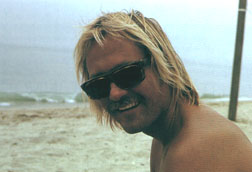 At Malibu 1973 - Photo John Kiewit |
Costa Rica was pristine in the early-seventies and I understand that
certain special spots haven't changed all that much since then. But after I returned to Malibu
and saw how crowded and polluted Santa Monica Bay had become, I started thinking about moving on again.
Bill Cleary was having similar thoughts so we sat down with a stack of maps to plan a safari 'Downunder'. The idea was to visit some old Topanga Beach friends (Doug & Reva Meredith and their sons) in New Zealand then fly across the 'ditch' to OZ for some serious surfing. Final destination, Western Australia. |
As Kiwi surfer, Michael Fitzharris, said when I interviewed him for an article on the renaissance of New Zealand 'longboarding' in Pacific Longboarder, "It wasn’t so much that the fun went out of surfing after the shortboard revolution, it was that it was much harder to get that fun." It was also harder to paddle into a wave, harder to balance changing priorities and harder to compete with hostile, increasingly younger shortboard riders who seemed to think they invented surfing and owned every wave. I don’t think I’m the only 'mature' surfer to have welcomed the longboard renaissance, and now that 60% of all new board sales in the USA are for longboards, it would appear that longboards, shortboards and hybrids (and their riders) are sharing more and more waves. This renaissance has also engendered an renewed interest in surfing’s
history and what it was like way back when. This site is my attempt to pay
homage to the memory of those magic, golden days. I hope you enjoy it.
©Robert R. Feigel 2001, 2005 - All Rights Reserved |